FAFSA Simplification Act: Boosting College Aid by 10% for Fall 2025

The FAFSA Simplification Act, effective Fall 2025, overhauls financial aid calculations, promising a potential 10% increase in aid for college students through a streamlined application process and revised eligibility criteria.
The landscape of college financial aid is undergoing a significant transformation with the implementation of the FAFSA Simplification Act, set to impact students starting Fall 2025. This landmark legislation aims to streamline the application process, expand eligibility, and potentially increase financial aid for countless students across the United States. It’s a change that promises to reshape how families plan and pay for higher education.
The Genesis of Change: Why FAFSA Needed Simplification
For decades, the Free Application for Federal Student Aid (FAFSA) has been the gateway to federal grants, scholarships, and loans. However, its complexity and length often presented significant barriers for families, particularly those with limited resources or English proficiency. The original FAFSA form, with its numerous questions and intricate calculations, could be daunting, leading many eligible students to miss out on crucial financial support.
The need for reform became increasingly apparent as college costs continued to rise, placing a greater burden on families. Policymakers recognized that a simpler, more accessible system was essential to ensure equitable access to higher education. The goal was not just to simplify the form, but to fundamentally rethink how financial need is assessed, making the process more transparent and student-centered. This push for simplification culminated in the passage of the FAFSA Simplification Act, a bipartisan effort to modernize federal student aid programs.
Addressing Historical Barriers
The previous FAFSA system, while well-intentioned, often created unintended obstacles. Families with complex financial situations, such as small business owners or those with farm income, found the previous calculations particularly challenging. Furthermore, the application often required information that was difficult to retrieve, creating unnecessary stress and delays. The Act directly addresses these pain points.
- Reduced Complexity: Significantly fewer questions on the application form.
- Streamlined Data Retrieval: Enhanced integration with IRS data for easier income reporting.
- Improved User Experience: A more intuitive and mobile-friendly application interface.
Ultimately, the FAFSA Simplification Act represents a critical step towards dismantling these historical barriers, ensuring that the financial aid process is no longer a deterrent but rather a clear pathway to educational opportunity. By making the application more user-friendly and reducing the administrative burden, it seeks to empower more students to pursue their academic dreams without being overwhelmed by bureaucracy. This foundational change is expected to have a ripple effect, increasing overall participation and reducing the number of students who forgo higher education due to perceived financial hurdles.
Key Changes Introduced by the FAFSA Simplification Act
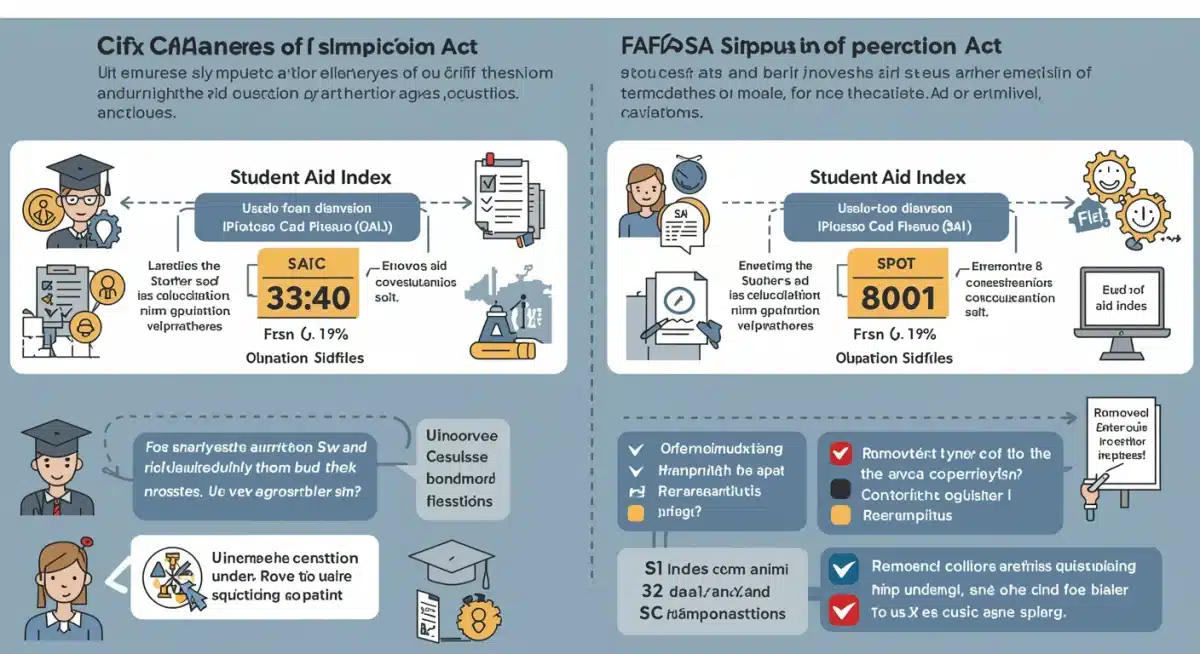
The FAFSA Simplification Act brings a host of pivotal changes that will redefine how financial aid is determined and disbursed. One of the most significant shifts is the replacement of the Expected Family Contribution (EFC) with the Student Aid Index (SAI). This new index is designed to be a more accurate and equitable measure of a student’s ability to pay for college, moving away from a system that often required families to contribute more than they realistically could.
Beyond the SAI, the Act also introduces changes to how certain assets are considered, simplifies the treatment of untaxed income, and expands eligibility for federal Pell Grants. These adjustments are not merely cosmetic; they represent a fundamental restructuring aimed at making financial aid more accessible and generous for a broader range of students. The intent is to ensure that a student’s financial background is less of a barrier to accessing higher education.
The Student Aid Index (SAI) vs. Expected Family Contribution (EFC)
The EFC, a familiar term to generations of students, calculated a family’s financial strength and dictated how much they were expected to contribute to college costs. The SAI, however, offers a new perspective. Unlike the EFC, the SAI can be a negative number, indicating a higher level of financial need and potentially increasing eligibility for maximum Pell Grant awards. This change is particularly beneficial for low-income students.
- Zero SAI: Replaces the zero EFC, indicating maximum Pell Grant eligibility.
- Negative SAI: Allows for a more precise assessment of extreme financial need.
- Simplified Calculation: Fewer variables and clearer guidelines for determining a family’s contribution.
The shift to the SAI is more than just a name change; it’s a philosophical pivot towards recognizing and supporting students with the greatest financial need. By allowing for a negative index, the system can now better differentiate between families who can contribute very little and those who genuinely have no capacity to contribute at all, ensuring that aid is directed where it is most needed. This nuanced approach is expected to lead to a more equitable distribution of federal student aid.
New Aid Calculations: How Your Financial Aid Will Be Determined
The new aid calculations under the FAFSA Simplification Act are designed to be more transparent and student-friendly. The formula for the Student Aid Index (SAI) considers several factors, including income, assets, and family size, but with some crucial modifications. For instance, the Act removes the deduction for the number of children in college, a change that could affect families with multiple children pursuing higher education simultaneously. However, other adjustments aim to offset this.
A significant improvement is the direct data exchange with the IRS, which will automatically import tax information into the FAFSA form for most applicants. This not only reduces the number of questions students and families need to answer but also minimizes errors and speeds up the application process. It’s a move towards a more seamless and less burdensome experience, allowing students to focus more on their academic pursuits and less on navigating complex financial paperwork.
Impact on Pell Grant Eligibility
One of the most impactful changes involves Pell Grant eligibility. The Act expands eligibility for Pell Grants by linking it to family size and the federal poverty level. This means more students from low-income backgrounds will qualify for the maximum Pell Grant award, providing a substantial boost to their financial aid packages. The simplified FAFSA form itself will also make it easier for eligible students to access these funds.
- Expanded Eligibility: More students from low-income families will qualify for Pell Grants.
- Automatic Maximum Awards: Certain income levels will automatically qualify for the maximum Pell Grant.
- Simplified Application: Easier access to Pell Grants through a streamlined process.
These changes to Pell Grant eligibility are expected to be a game-changer for many students, providing a more robust safety net for those who need it most. By increasing the number of recipients and ensuring a more straightforward path to receiving these grants, the FAFSA Simplification Act reinforces the federal government’s commitment to making higher education affordable and accessible to all, regardless of their socioeconomic background. This expansion of Pell Grants is a cornerstone of the Act’s broader goal.
Potential 10% Boost in Financial Aid: What It Means for You
The most exciting prospect of the FAFSA Simplification Act is the potential for a 10% boost in financial aid for college students. This estimate is based on projections from the Department of Education and various financial aid experts, who anticipate that the new calculation methodology and expanded eligibility criteria will result in more generous aid packages overall. While not every student will see an exact 10% increase, the general trend points towards a significant positive impact for many.
This potential increase can manifest in various ways, such as larger Pell Grant awards, increased eligibility for subsidized loans, or a greater amount of institutional aid based on the new SAI. For families struggling with the rising costs of tuition, books, and living expenses, even a modest increase in financial aid can make a substantial difference, potentially reducing the need for private loans or part-time work that could detract from academic focus.
Who Benefits Most from the Increase?
While the Act aims to benefit a broad spectrum of students, certain groups are poised to gain the most from these changes. Low-income students, those from single-parent households, and individuals who were previously marginalized by the EFC formula are likely to see the most significant improvements in their aid eligibility. The simplified application process itself will also benefit those who found the previous form too intimidating or confusing.
- Low-Income Students: Expected to receive larger Pell Grant awards and overall aid.
- Single-Parent Households: New calculations may be more favorable to these families.
- First-Generation Students: Simplified process makes applying for aid less daunting.
The anticipated 10% boost in financial aid is not merely a statistical figure; it represents tangible relief for families and a greater opportunity for students to pursue their educational aspirations. By targeting aid more effectively and expanding the pool of eligible recipients, the FAFSA Simplification Act endeavors to alleviate financial stress and foster an environment where a college education is within reach for more Americans. This increase is a testament to the Act’s commitment to educational equity.
Preparing for the FAFSA Simplification Act: A Student’s Guide
As the Fall 2025 implementation date approaches, students and families should begin preparing for the new FAFSA process. While the goal is simplification, understanding the changes beforehand can help ensure a smooth application experience. One of the most important steps is to gather all necessary financial documentation, even if the new form will auto-import much of it. Having these documents readily available can prevent delays.
Students should also familiarize themselves with the concept of the Student Aid Index (SAI) and how it differs from the previous Expected Family Contribution (EFC). While the exact impact on individual aid packages will vary, understanding the new calculation methodology can help set realistic expectations. Colleges and financial aid offices are also gearing up for these changes, so staying informed through their resources will be crucial.
Essential Steps for Applicants
Proactive preparation can significantly reduce stress and improve outcomes when applying for financial aid under the new Act. The Department of Education will be releasing updated guidance and tools, and utilizing these resources will be key. Engaging with high school counselors and college financial aid advisors can also provide personalized insights and support tailored to specific situations.
- Create an FSA ID: This remains essential for accessing federal student aid online.
- Understand the SAI: Familiarize yourself with the new financial needs assessment.
- Stay Informed: Follow updates from the Department of Education and your chosen colleges.
By taking these preparatory steps, students can position themselves to navigate the new FAFSA process with confidence. The simplification efforts are designed to make financial aid more accessible, but a proactive approach from applicants will maximize the benefits. Being well-informed and organized will be the best strategy for securing the financial support needed for higher education under the revised system.
Long-Term Impact and Future of Financial Aid
The FAFSA Simplification Act is not just an immediate change; it represents a foundational shift that will have long-term implications for the landscape of higher education finance. By making federal student aid more accessible and equitable, the Act aims to increase college enrollment rates, particularly among underserved populations. This could lead to a more diverse student body and a more skilled workforce in the years to come.
Furthermore, the simplification of the application process may encourage more students to apply for aid who previously felt overwhelmed or ineligible. This increased participation could lead to a more efficient allocation of federal resources, ensuring that financial assistance reaches those who need it most. The Act also sets a precedent for future reforms, potentially paving the way for even greater streamlining and support for college students.
Addressing Equity and Access
At its core, the FAFSA Simplification Act is an equity initiative. By removing barriers and expanding Pell Grant eligibility, it directly addresses disparities in access to higher education. The goal is to ensure that a student’s socioeconomic background does not dictate their educational opportunities, fostering a more inclusive and just system. This focus on equity is a critical component of the Act’s long-term vision.
- Increased Enrollment: Expected to boost college attendance rates among diverse groups.
- Reduced Disparities: Aims to level the playing field for students from all backgrounds.
- Sustainable Model: Creates a more robust and responsive financial aid system for the future.
The long-term impact of the FAFSA Simplification Act extends far beyond individual aid packages; it promises to fundamentally reshape the educational ecosystem. By prioritizing accessibility and equity, it lays the groundwork for a future where higher education is a realistic aspiration for a greater number of Americans, ultimately strengthening both individual lives and the nation’s economic and social fabric. This forward-looking approach underscores the significance of the reforms.
| Key Change | Brief Description |
|---|---|
| EFC Replaced by SAI | Expected Family Contribution (EFC) is replaced by the Student Aid Index (SAI), which can be negative. |
| Simplified FAFSA Form | Fewer questions and enhanced data exchange with the IRS for easier application. |
| Expanded Pell Grant Eligibility | More students, especially low-income, will qualify for maximum Pell Grant awards. |
| Potential Aid Increase | Projections suggest a potential 10% boost in overall financial aid for many students. |
Frequently Asked Questions About the FAFSA Simplification Act
The primary goal is to simplify the federal student aid application process, expand eligibility for financial assistance, and provide a more equitable distribution of aid, ultimately making college more accessible and affordable for a wider range of students.
The FAFSA Simplification Act is slated to take full effect for the 2024-2025 award year, meaning students applying for financial aid for college starting in Fall 2025 will be subject to the new rules and processes.
The SAI replaces the EFC and is a more holistic measure of a student’s ability to pay for college. Unlike the EFC, the SAI can be a negative number, indicating a higher level of financial need and potentially greater aid eligibility.
Yes, Pell Grant eligibility is expected to expand significantly. The Act links eligibility to family size and the federal poverty level, allowing more low-income students to qualify for maximum Pell Grant awards, thereby increasing access to federal grants.
Students should ensure they have an FSA ID, familiarize themselves with the concept of the SAI, and stay updated with information from the Department of Education and their prospective colleges’ financial aid offices. Proactive preparation is key to a smooth application.
Conclusion
The FAFSA Simplification Act marks a pivotal moment in the history of federal student aid, promising a more accessible, equitable, and generous financial aid system for college students starting Fall 2025. By streamlining the application process, replacing the EFC with the SAI, and expanding Pell Grant eligibility, the Act is poised to alleviate financial burdens and open doors to higher education for countless individuals. While the full impact will unfold over time, the anticipated 10% boost in financial aid signifies a clear commitment to supporting students and investing in the future. Staying informed and preparing proactively will be crucial for students and families to fully leverage these transformative changes.