Child Tax Credit 2026: Are You Eligible for the Increased $3,600 per Child? A Recent Update

The landscape of family financial support in the United States is constantly evolving, and few provisions capture the attention of parents and policymakers quite like the Child Tax Credit (CTC). As we look towards 2026, there’s significant discussion and anticipation surrounding potential changes to this crucial benefit, particularly the possibility of an increased $3,600 per child. For many families, understanding the nuances of the Child Tax Credit 2026 and its eligibility requirements could mean the difference between financial struggle and a greater sense of security. This comprehensive guide aims to demystify the upcoming changes, help you determine your potential eligibility, and shed light on what these updates could mean for your household.
The Child Tax Credit has a rich history, designed to alleviate the financial burden of raising children and support working families. Its structure has seen various adjustments over the years, often reflecting economic conditions and political priorities. The most recent significant enhancement occurred in 2021 through the American Rescue Plan, which temporarily increased the credit to $3,600 for children under six and $3,000 for children aged six to seventeen, made it fully refundable, and allowed for advance monthly payments. However, these enhanced provisions largely expired at the end of 2021, reverting the credit to its pre-2021 structure for subsequent tax years, with a maximum of $2,000 per child and stricter refundability rules.
Now, as the calendar inches closer to 2026, the discussion around reinstating or even permanently adopting some of these enhanced benefits is gaining momentum. The potential return of a $3,600 per child credit for the Child Tax Credit 2026 is not just a rumor; it’s a topic of active legislative debate, driven by advocates who highlight its proven impact on reducing child poverty and supporting middle-class families. Understanding these ongoing discussions is vital for anyone planning their financial future.
Understanding the Current Child Tax Credit Landscape
Before diving into the potential future of the Child Tax Credit 2026, it’s essential to grasp the current state of the credit. For the 2023 tax year (filed in 2024), the Child Tax Credit largely reverted to the provisions established by the Tax Cuts and Jobs Act (TCJA) of 2017. Here’s a quick overview of what that means:
- Maximum Credit Amount: Up to $2,000 per qualifying child.
- Age Limit: The child must be under the age of 17 at the end of the tax year (i.e., 16 or younger).
- Refundability: Up to $1,600 of the credit is refundable as the Additional Child Tax Credit (ACTC) for 2023, meaning eligible families can receive it even if they owe no federal income tax. This amount is adjusted for inflation.
- Income Thresholds: The credit begins to phase out for single filers with a Modified Adjusted Gross Income (MAGI) over $200,000, and for married couples filing jointly with a MAGI over $400,000.
- Residency Requirement: The child must have a Social Security number (SSN) and live with the taxpayer for more than half the year.
These are the rules currently in effect, and without new legislation, they are what families can expect for the immediate future. The push for a $3,600 credit in 2026 stems from a desire to revive the more generous, fully refundable structure that proved highly effective in 2021. This context is crucial as we examine the proposals for the Child Tax Credit 2026.
The Path to $3,600 per Child in 2026: Legislative Debates and Proposals
The prospect of an increased Child Tax Credit 2026, specifically to $3,600 per child, is tied directly to ongoing legislative efforts. The expiration of the enhanced CTC provisions from the American Rescue Plan has left many families advocating for their return. Several proposals have been introduced in Congress, aiming to expand the credit once again.
Key Legislative Considerations:
- Permanence vs. Temporary Extension: One of the central debates revolves around whether any enhancements should be permanent or temporary. Advocates for families often push for permanent changes to provide long-term stability and planning for households.
- Refundability: The full refundability of the 2021 CTC was a game-changer for low-income families, allowing them to benefit from the credit even if they owe no federal income tax. Reinstating full refundability is a major goal for many proposed changes to the Child Tax Credit 2026.
- Credit Amount and Age: While $3,600 for younger children and $3,000 for older children was the 2021 standard, discussions continue on optimal amounts and whether age distinctions should be maintained.
- Income Thresholds: The income phase-out limits are another point of discussion. Some proposals suggest maintaining the higher phase-out thresholds to benefit a broader range of middle-class families, while others focus on targeting lower and middle-income households.
- Advance Payments: The 2021 monthly advance payments were praised for providing consistent financial support throughout the year. There’s interest in bringing back a similar system for the Child Tax Credit 2026.
One notable bipartisan effort that gained traction in late 2023 and early 2024 was the Tax Relief for American Families and Workers Act of 2024. While this act primarily focused on business tax breaks, it also proposed some enhancements to the Child Tax Credit, though not to the full $3,600 level for all children. It aimed to increase the refundable portion of the credit and adjust it for inflation more rapidly. While this specific bill faced hurdles, it highlights the ongoing dialogue and the possibility of future legislative packages that could include more substantial changes for the Child Tax Credit 2026.
The political climate, economic conditions, and the outcome of future elections will all play a significant role in determining the final shape of the Child Tax Credit by 2026. Families should remain attentive to news from Capitol Hill and advocacy groups.
Who Will Be Eligible for the Increased $3,600 Child Tax Credit in 2026?
Assuming legislative action leads to an increased Child Tax Credit 2026 of $3,600 per child, eligibility will likely hinge on several key factors, drawing inspiration from the 2021 framework. While the exact rules will depend on the final legislation, here’s a strong indication of what to expect:
Key Eligibility Criteria:
- Qualifying Child Definition:
- The child must be under a certain age at the end of the tax year. In 2021, this was under 18 (meaning 17 or younger). If the $3,600 credit returns, it might apply to children under six, with a slightly lower amount (e.g., $3,000) for those aged 6-17, mirroring the 2021 structure.
- The child must be your son, daughter, stepchild, foster child, brother, sister, half-brother, half-sister, stepbrother, stepsister, or a descendant of any of them.
- The child must have lived with you for more than half of the tax year.
- The child must not provide more than half of their own support for the year.
- The child must be claimed as a dependent on your tax return.
- The child must be a U.S. citizen, U.S. national, or U.S. resident alien.
- Social Security Number (SSN) Requirement:
- Crucially, the child must have a valid Social Security number (SSN) issued by the Social Security Administration by the due date of your tax return (including extensions). This is a consistent requirement across all versions of the CTC.
- Income Requirements and Phase-Outs:
- This is where the biggest changes typically occur. In 2021, the enhanced credit began to phase out for single filers with MAGI above $75,000, heads of household above $112,500, and married couples filing jointly above $150,000. These lower thresholds were specifically designed to target the credit more towards low- and middle-income families.
- However, the original TCJA phase-out thresholds ($200,000 for single filers, $400,000 for married filing jointly) still apply to the base $2,000 credit. If the $3,600 credit is reinstated, there could be a two-tiered phase-out system, or a new, unified set of income thresholds. It’s likely that higher-income families would see their credit reduced or eliminated entirely.
- The full refundability aspect is also tied to income. In 2021, even families with very low or no earned income could receive the full credit, which was a significant departure from previous rules. Reinstating this full refundability would be a key indicator of broad eligibility for the Child Tax Credit 2026.
- Residency and Filing Status:
- You must be a U.S. citizen or resident alien and file a federal income tax return. Your filing status (single, married filing jointly, head of household, etc.) will influence your income thresholds.
It’s important to remember that these are projections based on past legislation and ongoing discussions. The exact eligibility criteria for the Child Tax Credit 2026 will only be finalized once a new law is passed and signed. Families should keep an eye on official IRS guidance and legislative updates as 2026 approaches.

The Impact of an Enhanced Child Tax Credit on Families and the Economy
The temporary enhancement of the Child Tax Credit in 2021 provided a real-world demonstration of its potential impact. Studies from various research organizations, including Columbia University’s Center on Poverty and Social Policy, indicated a significant reduction in child poverty rates during the period the enhanced credit was in effect. If the Child Tax Credit 2026 sees a return to the $3,600 per child level, similar positive effects are anticipated.
Benefits for Families:
- Poverty Reduction: The most direct and celebrated impact is the lifting of children out of poverty. The credit provides a crucial financial safety net for low-income families, helping them meet basic needs like food, housing, and healthcare.
- Increased Financial Stability: For middle-income families, the credit can ease the burden of rising costs associated with raising children, such as childcare, education expenses, and extracurricular activities. This can free up household budgets for savings or investments.
- Improved Child Well-being: When families have more resources, children tend to experience better health outcomes, improved educational attainment, and greater overall well-being.
- Reduced Stress: Financial strain is a significant source of stress for parents. A more generous CTC can alleviate some of this pressure, allowing parents to focus more on their children’s development.
Broader Economic Impacts:
- Economic Stimulus: The Child Tax Credit acts as an economic stimulus, as families typically spend the additional funds on essential goods and services, boosting local economies.
- Workforce Participation: While some critics argue that expanded benefits might disincentivize work, evidence from the 2021 expansion suggested minimal impact on parental employment, and in some cases, it enabled parents to afford childcare, thus facilitating workforce participation.
- Long-Term Gains: Investments in children have long-term societal benefits, including a more educated and productive future workforce, reduced healthcare costs, and lower rates of crime.
The debate around the Child Tax Credit 2026 isn’t just about numbers; it’s about the kind of society we want to build. Proponents argue that investing in children through robust tax credits is an investment in the nation’s future prosperity and social equity. Opponents often raise concerns about the cost of such programs and their potential impact on the national debt, leading to the ongoing legislative tug-of-war.
Preparing for the Child Tax Credit 2026: What You Can Do Now
Even though the final details of the Child Tax Credit 2026 are yet to be determined, there are proactive steps families can take now to prepare and ensure they are well-positioned to claim any benefits they are eligible for.
Key Preparatory Steps:
- Stay Informed: Regularly check official sources like the IRS website (irs.gov), reputable financial news outlets, and congressional updates. Legislative developments can move quickly, and staying informed is your best defense against misinformation.
- Maintain Accurate Records: Keep meticulous records of your children’s Social Security numbers, birth certificates, and proof of residency. These documents are fundamental for establishing eligibility for any version of the Child Tax Credit.
- Monitor Your Income: Understand your Adjusted Gross Income (AGI) and Modified Adjusted Gross Income (MAGI). These figures are critical for determining if you fall within the income thresholds for the credit and its potential phase-outs. If you anticipate significant changes in income, consult with a tax professional.
- Update Filing Status: Ensure your tax filing status is correct. Changes in marital status or household composition can affect your eligibility and the amount of credit you can receive.
- Consult a Tax Professional: As 2026 approaches, and especially once new legislation is clearer, consider consulting with a qualified tax advisor. They can provide personalized guidance, help you understand complex rules, and ensure you claim all eligible credits.
- Engage with Advocacy Groups: Organizations dedicated to child welfare and family financial security often provide valuable insights and resources regarding tax credits. They also play a role in advocating for these benefits.
The period leading up to 2026 will be crucial for legislative action. By taking these preparatory steps, you can reduce stress and increase your confidence in navigating potential changes to the Child Tax Credit 2026.
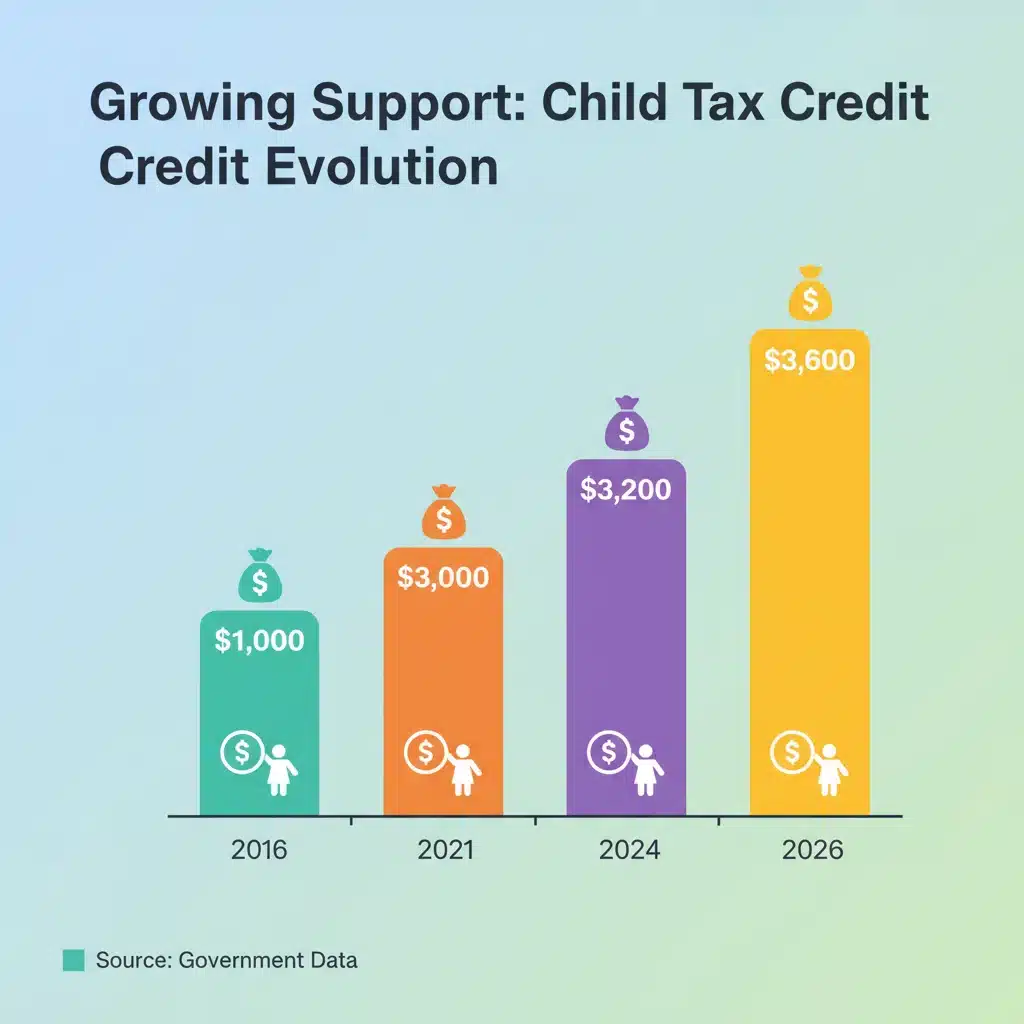
Comparing the Potential Child Tax Credit 2026 with Previous Versions
To fully appreciate the significance of a $3,600 Child Tax Credit 2026, it’s helpful to compare it with the credit’s recent history. The CTC has undergone substantial transformations, each with distinct implications for families.
Pre-2021 CTC (TCJA 2017 – 2020, and Post-2021):
- Maximum per Child: $2,000.
- Refundability: Up to $1,400 (adjusted for inflation, $1,600 for 2023) was refundable as the Additional Child Tax Credit (ACTC), and only if you had earned income above a certain threshold (e.g., $2,500). This meant many very low-income families might not receive the full benefit or any refundable portion.
- Age Limit: Under 17 (16 or younger).
- Main Income Phase-out: Began at $200,000 for single filers and $400,000 for married couples filing jointly.
- Advance Payments: Not available.
Enhanced CTC (American Rescue Plan 2021):
- Maximum per Child: $3,600 for children under 6; $3,000 for children aged 6-17.
- Refundability: Fully refundable. This was a critical change, allowing even families with no earned income to receive the full credit.
- Age Limit: Under 18 (17 or younger).
- Main Income Phase-out: A lower, additional phase-out began at $75,000 for single filers, $112,500 for heads of household, and $150,000 for married couples filing jointly. The original TCJA phase-outs still applied for higher incomes.
- Advance Payments: Available as monthly payments from July to December 2021.
Potential Child Tax Credit 2026 ($3,600 Scenario):
If the $3,600 credit is reinstated, it would likely adopt many features of the 2021 enhanced version. This would mean a more generous credit amount, broader refundability, and potentially lower income thresholds for some of the phase-out, aimed at providing more substantial support to families across the income spectrum, particularly those with low to moderate incomes.
- Likely Maximum per Child: $3,600 for children under 6; $3,000 for children aged 6-17 (similar to 2021).
- Likely Refundability: Fully refundable, ensuring that the lowest-income families benefit the most.
- Likely Age Limit: Under 18 (17 or younger).
- Income Phase-out: This is the most uncertain element. It could revert to the 2021 lower thresholds for the enhanced portion or be structured differently based on political compromise.
- Advance Payments: A strong possibility, given their popularity and effectiveness in 2021.
The key takeaway is that a $3,600 Child Tax Credit 2026 would represent a significant expansion of financial aid compared to the current $2,000 credit. This shift could have profound implications for millions of American families, offering a much-needed boost to household budgets and significantly impacting child poverty rates.
Common Misconceptions About the Child Tax Credit
The Child Tax Credit can be complex, leading to several common misunderstandings. Addressing these is crucial for families planning for the Child Tax Credit 2026.
- Misconception 1: It’s only for low-income families. While the enhanced 2021 CTC greatly benefited low-income families due to full refundability, the credit, in general, is available to a wide range of income levels, including many middle- and even some higher-income households, albeit with phase-outs. The $200,000/$400,000 income thresholds for the base credit are quite high.
- Misconception 2: You automatically receive it. No, the Child Tax Credit is claimed when you file your federal income tax return. While the 2021 version offered advance monthly payments, this was a temporary measure. Unless new legislation for the Child Tax Credit 2026 specifically includes advance payments, you’ll claim the credit when you file.
- Misconception 3: Any child qualifies. There are specific rules regarding age, relationship, residency, and support. For instance, a child must have a valid SSN, not an ITIN, to qualify for the CTC. They must also meet the age requirements and live with the taxpayer for more than half the year.
- Misconception 4: It’s the same as the Child and Dependent Care Credit. These are two distinct tax credits. The Child Tax Credit helps families with the overall cost of raising children, while the Child and Dependent Care Credit specifically helps with expenses incurred for childcare so you can work or look for work. You might be eligible for both.
- Misconception 5: It’s a loan that needs to be paid back. The Child Tax Credit is a credit, not a loan. If you receive a refundable portion, it reduces your tax liability dollar-for-dollar, and if it exceeds your tax liability, the remainder is paid to you as a refund. The only time you might need to ‘pay back’ a portion is if you received advance payments (as in 2021) and your eligibility changed significantly during the year, leading to an overpayment.
Understanding these distinctions is vital for accurate tax planning and ensuring you don’t miss out on benefits you’re entitled to for the Child Tax Credit 2026.
The Wider Context: Child Tax Credit and Economic Policy
The debate surrounding the Child Tax Credit 2026 is not isolated; it’s part of a broader discussion on economic policy, social safety nets, and government spending. The credit’s design reflects fundamental choices about how a society supports its youngest members and their families.
Points of Discussion in Policy Circles:
- Cost vs. Benefit: A central argument against a fully expanded CTC is its cost. Estimates for the 2021 expansion ran into hundreds of billions of dollars. Policymakers weigh this cost against the proven benefits in poverty reduction and economic stimulus.
- Targeting: There’s an ongoing debate about whether the CTC should be universally available, highly targeted to low-income families, or somewhere in between. The 2021 expansion leaned towards greater universality for low to middle incomes, while the current credit has higher income phase-outs.
- Work Requirements: Some lawmakers advocate for retaining or strengthening work requirements for refundable portions of the CTC, arguing it encourages workforce participation. Others contend that such requirements penalize families with stay-at-home parents or those unable to work due to disability or caregiving responsibilities.
- Inflation and Indexation: The value of the credit can erode over time due to inflation. Proposals for the Child Tax Credit 2026 often include provisions for indexing the credit amounts to inflation, ensuring its real value is maintained.
- Simplification: Tax credits can be complicated. Efforts are always underway to simplify the application and claiming process, making it easier for eligible families to access benefits without undue burden.
The legislative process is often one of compromise, and the final form of the Child Tax Credit 2026 will undoubtedly be a result of negotiations between various political factions. Families should pay close attention to any bipartisan efforts, as these often have the best chance of passing into law.
Conclusion: Navigating the Future of the Child Tax Credit
As we anticipate the potential changes to the Child Tax Credit 2026, the possibility of an increased $3,600 per child represents a significant opportunity for American families. While details are still being debated in Congress, the conversation highlights a collective recognition of the financial pressures faced by parents and the critical role that tax credits can play in fostering stability and reducing child poverty.
For parents and guardians, the key is to remain proactive and informed. Keep your financial records in order, understand the general eligibility criteria, and be ready to adapt as new legislation unfolds. The journey to the Child Tax Credit 2026 will be marked by legislative discussions, economic considerations, and the powerful voices of advocates who champion the well-being of children. By staying engaged, you can ensure your family is prepared to benefit from any enhancements that come to fruition.
The future of the Child Tax Credit is a testament to ongoing efforts to build a more supportive and equitable financial landscape for families across the nation. The potential for a $3,600 credit is not just a number; it’s a promise of greater security and opportunity for the next generation.