K-12 Curriculum Updates in Data Science and AI for 2026
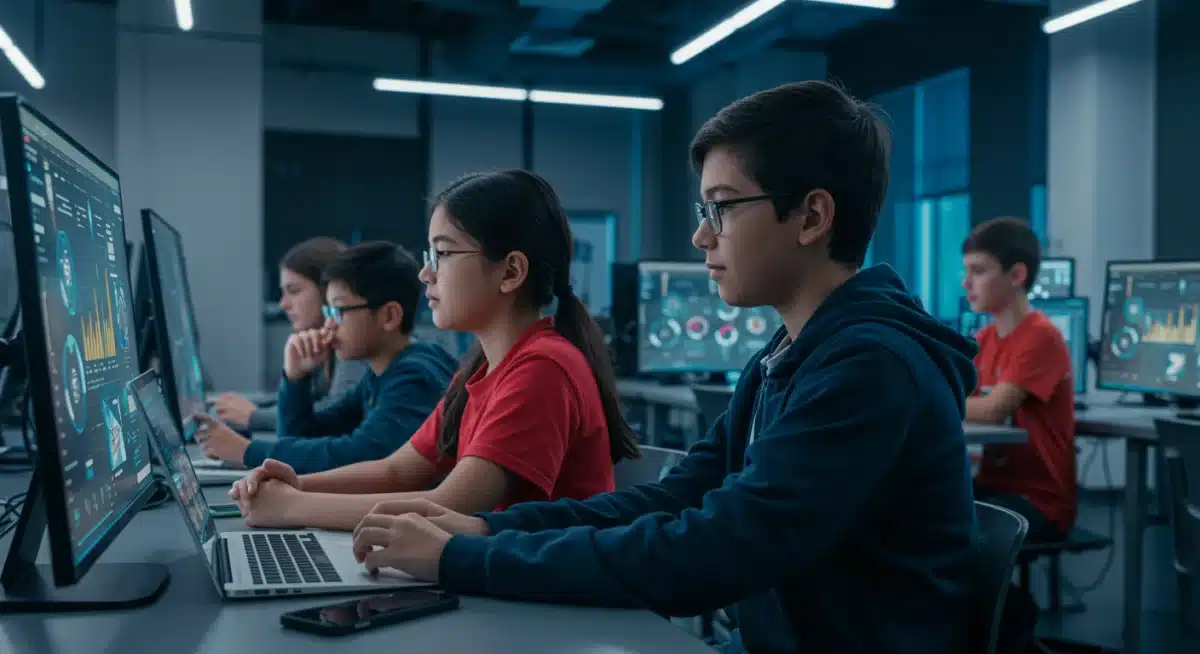
By 2026, K-12 curriculum updates in data science and AI are fundamentally transforming education, equipping students with essential skills for an increasingly technological world, emphasizing critical thinking and ethical considerations.
With 2026 fast approaching, the landscape of education is undergoing a significant transformation, particularly with the integration of emerging technologies. Are you ready to understand how K-12 curriculum updates in data science and AI for 2026 will reshape learning and prepare the next generation for an increasingly data-driven world?
The urgent need for data science and AI literacy
The rapid advancement of data science and artificial intelligence (AI) has profoundly impacted nearly every sector of society. From healthcare to finance, entertainment to agriculture, these technologies are driving innovation and efficiency. Consequently, preparing students with foundational knowledge in these areas is no longer a luxury but a necessity for their future success and for maintaining global competitiveness.
Educational systems across the United States are recognizing this imperative, leading to widespread discussions and implementations of curriculum changes. The goal is to ensure that students are not just consumers of technology, but informed, critical thinkers and ethical creators within the digital realm. This shift transcends simple computer literacy, aiming for a deeper understanding of how data is collected, analyzed, and used to make decisions, and how AI systems function and influence our lives.
Why integrate early?
Integrating data science and AI into the K-12 curriculum at an early stage offers numerous benefits. It cultivates computational thinking skills from a young age, encouraging problem-solving and logical reasoning. Early exposure also demystifies these complex fields, making them more accessible and fostering interest in STEM careers, particularly among underrepresented groups. Furthermore, it allows students to develop an ethical framework for technology use, addressing potential biases and societal impacts before they become entrenched.
- Fosters computational thinking and problem-solving.
- Demystifies complex technological concepts.
- Encourages diverse participation in STEM fields.
- Promotes early ethical considerations in technology.
Ultimately, the early integration of data science and AI ensures that students are not merely adapting to technological changes but are actively shaping the future. This proactive approach is crucial for building a workforce capable of innovating and addressing the complex challenges of the 21st century.
Key components of the 2026 curriculum updates
The K-12 curriculum updates for 2026 are meticulously designed to introduce data science and AI concepts progressively, aligning with students’ cognitive development at different grade levels. These updates are built upon a framework that balances theoretical understanding with practical application, ensuring students gain both knowledge and hands-on experience.
At the elementary level, the focus is on foundational concepts like data collection, organization, and simple pattern recognition. Activities might involve sorting objects, creating basic graphs, or understanding how algorithms make recommendations in familiar contexts. As students advance to middle school, the curriculum introduces more complex data analysis techniques, basic programming logic, and an exploration of what AI is and how it’s used in everyday applications.
High school: deeper dives and ethical considerations
In high school, the curriculum delves into more advanced topics. Students will engage with statistical analysis, machine learning principles, and various AI applications. This includes understanding supervised and unsupervised learning, neural networks, and the ethical implications of AI. Projects will often involve real-world data sets and encourage students to develop their own AI models or data visualizations.
- Data collection and visualization techniques.
- Introduction to programming languages (e.g., Python).
- Understanding machine learning algorithms.
- Ethical AI and data privacy discussions.
These components are not isolated; they are often integrated into existing subjects like mathematics, science, and even social studies, demonstrating the interdisciplinary nature of data science and AI. This holistic approach helps students see the relevance of these fields across different domains.
Integrating data science across subjects
One of the most innovative aspects of the 2026 K-12 curriculum updates is the emphasis on integrating data science and AI concepts across various subjects, rather than treating them as standalone disciplines. This interdisciplinary approach enhances learning by demonstrating the practical applications of data and AI in diverse contexts, making the learning experience more relevant and engaging for students.
For instance, in mathematics classes, students might analyze real-world datasets to understand statistical concepts, probability, and algebraic relationships. Science classes could involve collecting and interpreting experimental data using computational tools, or even simulating biological processes with AI models. This practical application transforms abstract concepts into tangible insights, fostering a deeper understanding.
AI in humanities and arts
The integration extends beyond STEM fields. In social studies, students might use data to analyze demographic trends, historical events, or economic indicators. They could explore how AI influences political discourse or shapes public opinion. Even in arts and literature, students can examine how AI is used in creative processes, from generating music to assisting with digital art, or how data analytics informs audience engagement with media.
- Math: Statistical analysis of real-world data.
- Science: Data-driven experimental analysis and simulations.
- Social studies: Analyzing demographic and historical data with computational tools.
- Arts: Exploring AI’s role in creative expression and audience engagement.
This cross-curricular integration helps students develop a comprehensive understanding of data science and AI, recognizing their pervasive influence and empowering them to apply these skills in a multitude of future careers and personal endeavors.
Teacher training and professional development
The success of the 2026 K-12 curriculum updates in data science and AI hinges critically on robust teacher training and ongoing professional development. Educators, many of whom may not have received formal training in these rapidly evolving fields during their own education, require comprehensive support to effectively deliver the new curriculum. This involves not only mastering the technical content but also developing pedagogical strategies suited for teaching complex concepts to diverse student populations.
States and school districts are investing heavily in programs designed to equip teachers with the necessary knowledge and skills. These programs often include intensive workshops, online courses, and collaborative learning communities where educators can share best practices and troubleshoot challenges. The aim is to build a strong cohort of confident and competent teachers who can inspire the next generation.
Ongoing support and resources
Beyond initial training, continuous professional development is crucial. The fields of data science and AI are constantly advancing, necessitating regular updates for educators. This includes access to new teaching materials, software, and hardware, as well as opportunities to connect with industry experts and researchers. Mentorship programs are also being established to provide ongoing guidance and support, particularly for teachers new to these subjects.
- Intensive workshops and online courses for content mastery.
- Collaborative learning communities for pedagogical support.
- Access to updated teaching materials and technological resources.
- Mentorship programs for continuous guidance.
By prioritizing teacher development, educational systems are ensuring that the curriculum updates are not just theoretical mandates but are effectively translated into meaningful learning experiences in every classroom.
Ethical considerations and data privacy
As data science and AI become integral to the K-12 curriculum, a paramount focus is placed on ethical considerations and data privacy. It is insufficient to simply teach students how these technologies work; they must also understand the profound societal implications and their responsibilities as digital citizens. This includes critical discussions around bias in algorithms, the responsible use of personal data, and the potential for misuse of powerful AI tools.
The curriculum incorporates modules dedicated to exploring ethical dilemmas posed by AI, such as fairness, accountability, and transparency. Students will learn to identify and question biases in data sets and algorithms, understanding how these can perpetuate or even amplify societal inequalities. They will also delve into the importance of data privacy, learning about concepts like data anonymization, consent, and the legal frameworks governing data protection.
Developing responsible digital citizens
These discussions are not abstract; they are grounded in real-world case studies and scenarios that students can relate to. For example, analyzing how facial recognition technology affects privacy or how recommendation algorithms can create echo chambers. The goal is to cultivate a generation of responsible digital citizens who can critically evaluate technology’s impact and advocate for ethical practices.
- Understanding algorithmic bias and its societal impact.
- Exploring data privacy principles and laws.
- Analyzing real-world ethical dilemmas in AI.
- Promoting responsible and ethical technology use.
By instilling a strong ethical foundation, the curriculum prepares students to navigate the complexities of the digital age with integrity and thoughtfulness, ensuring they contribute positively to technological advancements.
Challenges and opportunities in implementation

Implementing comprehensive K-12 curriculum updates in data science and AI by 2026 presents both significant challenges and unparalleled opportunities. One major challenge is equitable access to resources, including high-speed internet, appropriate hardware, and software, particularly in underserved communities. Bridging this digital divide is essential to ensure all students benefit from these advancements.
Another hurdle lies in curriculum standardization and adaptation. While national guidelines provide a framework, individual states and districts must tailor these to their specific contexts, which can lead to inconsistencies. Ensuring a coherent and progressive learning pathway from kindergarten through twelfth grade requires careful coordination and ongoing evaluation.
Opportunities for innovation
Despite these challenges, the opportunities are immense. These curriculum updates can foster unprecedented levels of innovation and engagement in the classroom. Project-based learning, interdisciplinary collaboration, and real-world problem-solving become more accessible and impactful with data science and AI tools. This shift can empower students to become creators and innovators, not just consumers of information.
- Addressing the digital divide for equitable access.
- Ensuring curriculum standardization and adaptation.
- Fostering innovation through project-based learning.
- Empowering students as creators and problem-solvers.
The journey to fully integrate data science and AI into K-12 education is complex, but the potential rewards—a generation of digitally literate, ethically aware, and innovative citizens—make it a worthwhile and necessary endeavor.
Future outlook: beyond 2026
The K-12 curriculum updates in data science and AI for 2026 are not an endpoint but rather a crucial milestone in an ongoing educational evolution. As technology continues to accelerate, the curriculum will need to remain agile and adaptive, constantly incorporating new advancements and pedagogical approaches. The foundation laid by 2026 will serve as a springboard for even more sophisticated and integrated learning experiences in the years that follow.
Looking beyond 2026, we can anticipate further specialization within AI and data science education. This might include more advanced modules on specific machine learning techniques, quantum computing concepts, or specialized areas like explainable AI (XAI) and responsible AI development. The emphasis will continue to be on practical application, critical thinking, and ethical leadership, preparing students for roles that may not even exist yet.
Lifelong learning and adaptability
The overarching goal is to cultivate lifelong learners who are adaptable and resilient in the face of continuous technological change. Education will increasingly focus on teaching students how to learn, unlearn, and relearn, equipping them with the meta-skills necessary to thrive in an unpredictable future. The curriculum will foster curiosity, creativity, and a proactive approach to understanding and utilizing emerging technologies.
- Continuous adaptation to technological advancements.
- Specialization in advanced AI and data science topics.
- Focus on lifelong learning and adaptability.
- Cultivating curiosity and creative problem-solving.
Ultimately, the future of K-12 education in data science and AI is about preparing students not just for specific jobs, but for a dynamic world where technological literacy and ethical discernment are paramount for personal and collective well-being.
| Key Update Area | Brief Description |
|---|---|
| Early Integration | Introducing data science and AI concepts progressively from elementary grades to high school. |
| Cross-Curricular Approach | Integrating data science and AI into math, science, social studies, and even arts. |
| Teacher Development | Extensive training and ongoing professional support for educators to teach new concepts. |
| Ethical Literacy | Focus on algorithmic bias, data privacy, and responsible AI use to foster digital citizenship. |
Frequently asked questions about K-12 curriculum updates
The main goal is to equip students with foundational knowledge and critical thinking skills in data science and AI, preparing them for an increasingly digital world and future careers. It aims to foster informed, ethical creators and users of technology from an early age.
These concepts will be woven into various subjects. For example, math classes might use data analysis, science classes could interpret experimental data, and social studies could explore AI’s impact on society, making learning more relevant and interdisciplinary.
Teachers will undergo comprehensive professional development, including workshops, online courses, and collaborative learning. The focus is on content mastery, pedagogical strategies, and ongoing support to ensure effective delivery of the new material in classrooms.
Understanding the ethical implications of AI and data privacy is crucial for responsible digital citizenship. The curriculum teaches students to identify biases, understand data protection, and critically evaluate technology’s societal impact, fostering integrity in the digital age.
Challenges include ensuring equitable access to technology and resources across all schools, standardizing curriculum adaptation across diverse districts, and continuously updating content to keep pace with rapid technological advancements. Overcoming these requires sustained effort.
Conclusion
The K-12 curriculum updates in data science and AI for 2026 represent a monumental shift in educational philosophy, moving towards a future where digital literacy is as fundamental as traditional subjects. By integrating these critical fields from an early age, fostering interdisciplinary learning, and prioritizing ethical considerations, educational systems are proactively preparing students for the complexities and opportunities of an AI-driven world. While implementation presents its challenges, the commitment to robust teacher training and equitable access underscores a collective vision: to cultivate a generation of innovative, critical, and ethically aware citizens ready to thrive in the 21st century and beyond. This ongoing evolution ensures that education remains relevant, empowering every student to shape a more informed and responsible future.